Some lunches require planning. This one requires a tortilla and about ten minutes. The turkey and hummus veggie wrap has become a weekday staple for a simple reason: it swaps the usual mayo-and-deli-meat routine for a combination that actually keeps you full, leans on fiber-rich chickpeas instead of refined fat, and still tastes like something you’d want to eat twice in the same week.
Here’s the full recipe, followed by the nutrition reasoning behind it, some practical swaps, and how long it actually holds up if you’re making it ahead for the week.
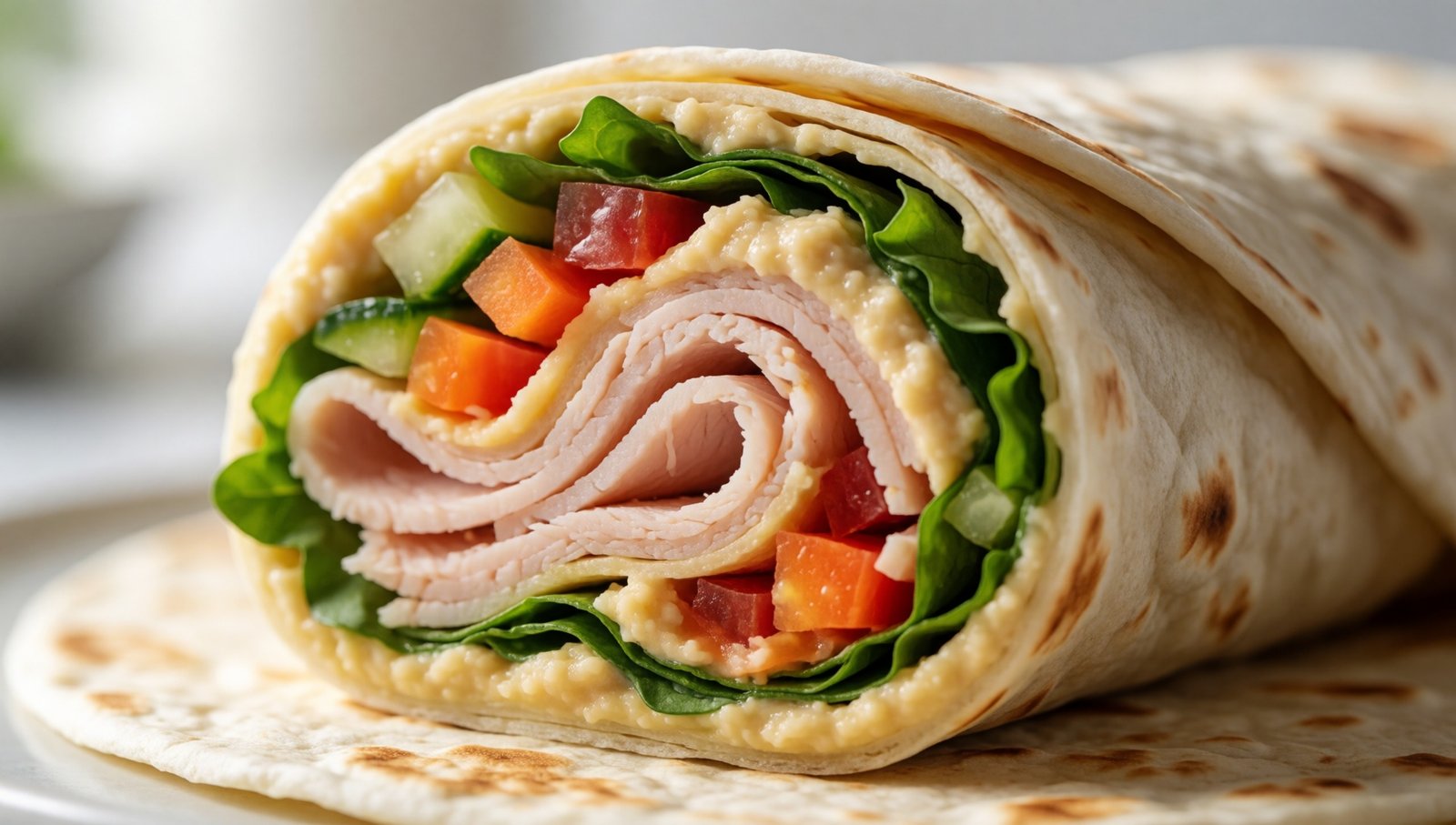
Turkey and Hummus Veggie Wrap
Ingredients
Method
- Lay the tortilla flat and spread the hummus over it, leaving a small border.
- Layer the greens, turkey, cucumber, pepper, carrot and avocado in the center.
- Season with black pepper.
- Fold in the sides, then roll up tightly from the bottom. Cut in half diagonally.
Notes
Why Hummus Instead of Mayo Makes a Real Difference
Swapping hummus for mayonnaise isn’t just a flavor preference — it changes the nutritional shape of the whole lunch. Hummus is made primarily from chickpeas, a legume that the Harvard T.H. Chan School of Public Health’s Nutrition Source notes can increase fullness: the group reports that eating around one daily serving of beans, chickpeas, lentils, or peas is associated with greater satiety, which is exactly what you want from a midday meal that has to carry you to dinner.
Chickpeas and other legumes are also a source of soluble fiber, and according to the Mayo Clinic, soluble fiber “can help lower cholesterol and blood sugar” by slowing digestion. Mayonnaise, by contrast, contributes calories mostly from oil with essentially no fiber, protein, or micronutrients. You’re not losing much by leaving it out of this wrap, and you’re gaining a creamy spread that’s doing nutritional work instead of just adding richness.
The Case for Lean Turkey
Poultry is consistently recommended as one of the better protein choices for regular eating. Harvard’s Nutrition Source lists poultry alongside seafood as “your best bet” among animal proteins, and protein is the macronutrient doing the heavy lifting in a lunch that needs to prevent the 3 p.m. energy crash. Turkey breast brings that protein with relatively little saturated fat compared to higher-fat cuts of meat.
One important caveat worth passing along: sliced deli turkey is a processed meat, and Harvard’s guidance on carbohydrates and blood sugar notes that it’s worth limiting processed meats as a category, mainly because of their sodium content. The Mayo Clinic makes a similar point in its guidance on taming sodium intake, noting that fresh meat runs lower in sodium than lunchmeat. The practical takeaway isn’t to avoid turkey wraps — it’s to look for a lower-sodium, minimally processed turkey breast when you’re shopping, and to let the vegetables and hummus in this recipe do some of the flavor work instead of relying on extra salt.
What the Vegetables Are Actually Doing Here
It’s easy to treat the spinach, cucumber, bell pepper, and carrot in this wrap as garnish, but they’re doing real nutritional work. Harvard’s Nutrition Source points out that a diet rich in vegetables and fruit is linked to lower blood pressure and a reduced risk of heart disease and stroke, and recommends building meals with a variety of vegetable types — dark green leafy, red, and others are all represented in this one wrap. Piling on color isn’t just an aesthetic choice; it’s a reasonable proxy for getting a wider range of vitamins and plant compounds in a single sitting.
Choosing the Tortilla
The tortilla matters more than it gets credit for. The Mayo Clinic specifically recommends using whole-wheat tortillas instead of white-flour ones as an easy whole-grain swap, noting that refining wheat strips out nearly all of its natural fiber. Harvard’s whole grains guidance adds that refining also removes more than half of wheat’s B vitamins and most of its vitamin E. A whole-wheat or high-fiber tortilla keeps that intact, and it’s one of the simplest single swaps you can make in a sandwich-style lunch without changing anything else about how it tastes.
Easy Variations
This wrap is flexible by design. A few swaps that keep the same nutritional profile:
- No turkey on hand? Grilled chicken, canned tuna, or extra chickpeas all work as the protein base — chickpeas make it fully plant-based.
- Want more fiber? Add shredded red cabbage or a few extra spinach leaves; both add volume and crunch without many calories.
- Dairy-free or avoiding mayo-adjacent spreads entirely? Hummus already covers that, but a smashed avocado layer on top adds healthy fats if you want more staying power.
- Lower-carb version? Swap the tortilla for a large lettuce leaf or collard green wrap; the filling works just as well.
Meal Prep and Food Safety
This wrap is genuinely meal-prep friendly, but it’s worth being precise about how long it keeps. The Mayo Clinic’s guidance on food safety and leftovers states that refrigerated leftovers are generally safe for 3 to 4 days, which is a reasonable window to use for a wrap containing cooked turkey. To keep the tortilla from getting soggy over that time, wrap it tightly in foil or parchment paper rather than an open container, and consider keeping any avocado on the side until just before eating, since it browns faster than the other ingredients.
If you’re prepping a batch for the week, assemble two or three wraps at the start and plan to make fresh ones again by day four rather than stretching the same batch across five workdays. It’s a small habit that avoids both food waste and food safety guesswork.
Rounding Out the Meal
On its own, this wrap already balances protein, fiber, and vegetables, but it pairs naturally with a piece of fruit or a small side salad if you want a more complete plate. If you’re trying to hit a specific protein target for the day, it helps to know roughly how much you actually need — our age-by-age protein guide breaks that down. And if fiber is more your focus, the practical guide to daily fiber needs explains why meals like this one, built around chickpeas and vegetables, add up over a full day.
If hummus and chickpeas end up becoming a regular part of your lunch rotation, it’s worth branching out beyond the wrap format — our Mediterranean chickpea and quinoa power bowl uses the same base ingredients in a heartier, bowl-style lunch that’s just as quick to put together.
The Bottom Line
A good lunch doesn’t need to be complicated to be nutritionally sound. This wrap takes ten minutes, uses ingredients most people already have on a given week, and makes a few quiet upgrades — hummus instead of mayo, whole-wheat instead of white, a handful of vegetables instead of none — that add up to a meal with real staying power. Keep a batch of hummus and a bag of tortillas on hand and this becomes less of a “recipe” and more of a default.
This article is for general information and isn’t medical advice. If you have specific health conditions or dietary restrictions, talk with a doctor or registered dietitian about what’s right for you.
Leave a Reply