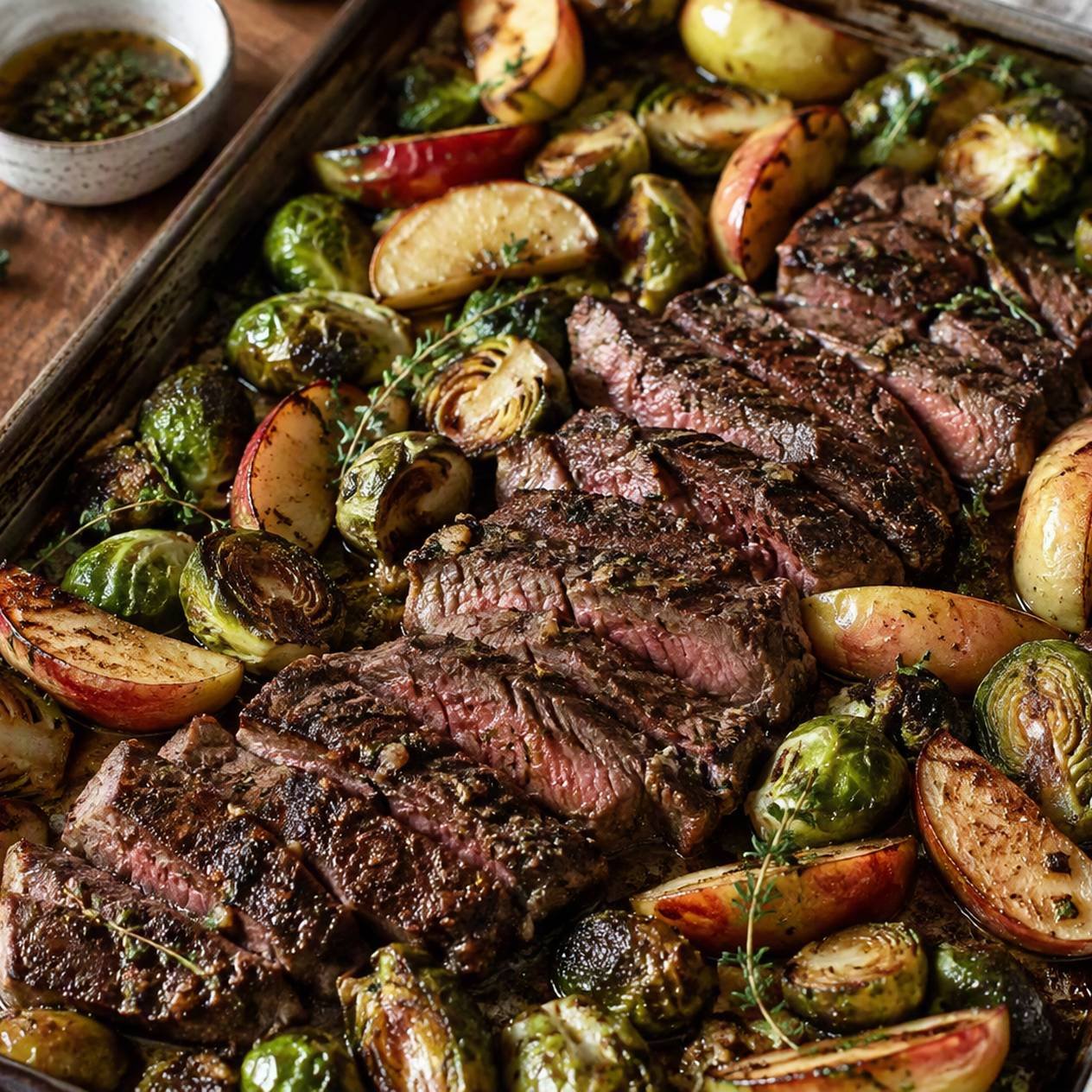
A good steak dinner doesn’t need a grill, a cast-iron skillet, or much hands-on attention at all. This sheet-pan version roasts top sirloin steaks alongside apples and Brussels sprouts on a single pan, so the fruit caramelizes, the sprouts crisp at the edges, and the steak comes out juicy with almost no babysitting required.
Why Top Sirloin Works So Well for Sheet-Pan Dinners
Top sirloin is one of the leaner, more affordable beef steaks, and it roasts reliably in individual portions — which matters for a sheet-pan dinner, since the steak needs to finish around the same time as the vegetables scattered around it. Cut into 6 to 8-ounce portions, it typically reaches a safe internal temperature in 18 to 22 minutes at 400°F, right in line with how long it takes Brussels sprouts to brown and apples to soften.
Getting the Temperature Right
The one number worth knowing by heart: the USDA recommends cooking whole cuts of beef — steaks and roasts — to an internal temperature of 145°F, then letting the meat rest for three minutes before carving or eating. A $10 instant-read thermometer takes the guesswork out of this completely — pull the pan when the thickest part of the steak hits 145°F, tent it loosely with foil, and let it rest while the vegetables finish. That short rest also lets the juices redistribute, so the steak stays tender instead of losing all its moisture the moment you slice it.
Sheet-Pan Garlic Butter Steak with Roasted Apples and Brussels Sprouts
Serves: 4 | Prep time: 15 minutes | Cook time: 20 minutes
Ingredients
- 4 top sirloin steaks (6 to 8 ounces each), about 1 inch thick
- 1 pound Brussels sprouts, halved (quartered if large)
- 2 medium apples (Honeycrisp or Gala), cored and cut into 1-inch wedges
- 1 small red onion, cut into wedges
- 3 tablespoons olive oil, divided
- 2 tablespoons unsalted butter, melted
- 2 cloves garlic, minced
- 2 teaspoons fresh rosemary or thyme, chopped (or 1 teaspoon dried)
- 1 tablespoon maple syrup or honey
- Salt and black pepper, to taste
Instructions
- Preheat the oven to 400°F and line a large sheet pan with parchment paper or foil. Let the steaks sit at room temperature for about 15 minutes while you prep the vegetables.
- In a large bowl, toss the Brussels sprouts, apples, and red onion with 2 tablespoons of the olive oil, half the rosemary, salt, and pepper. Spread them in a single layer across the pan, leaving room for the steaks.
- Stir the melted butter, garlic, and remaining rosemary together. Pat the steaks dry, rub them with the remaining 1 tablespoon of olive oil, and season generously with salt and pepper. Place them in the cleared space on the pan and brush the tops with the garlic butter.
- Roast for 18 to 22 minutes, stirring the vegetables once halfway through, until the steaks reach an internal temperature of 145°F at their thickest point and the Brussels sprouts are browned at the edges.
- Remove the pan from the oven, drizzle the maple syrup or honey over the apples and sprouts, and tent the steaks loosely with foil. Let everything rest for 3 minutes.
- Slice the steaks against the grain and serve alongside the roasted vegetables and apples.
What the Beef Is Bringing to the Plate
Top sirloin is one of the leaner beef steaks, and beef in general shows up on Harvard’s Nutrition Source as one of the meats that’s rich in zinc, a mineral involved in immune function and wound healing. The Cleveland Clinic also lists beef among the foods richest in heme iron — the form of iron found in meat, poultry, and seafood, which the body absorbs more readily than the non-heme iron found in plant foods. Pairing it with Brussels sprouts’ vitamin C may help with that absorption further, since vitamin C is known to support non-heme iron uptake from the rest of the plate.
That said, Harvard’s general dietary guidance is to enjoy red meat in moderation — leaning more often on fish, poultry, beans, and nuts, and limiting red meat and processed meats as an everyday habit. Choosing a leaner cut like top sirloin, trimming visible fat, and treating a steak dinner as an occasional meal rather than a nightly one keeps this recipe in line with that advice.
What the Brussels Sprouts Are Bringing to the Table
Brussels sprouts tend to get treated as a side dish you tolerate rather than one you look forward to, but roasted until the outer leaves crisp and caramelize, they’re a genuinely different vegetable than the boiled version many of us grew up with — and they’re doing real nutritional work on the plate. According to the Cleveland Clinic, a half-cup serving of cooked Brussels sprouts has about 28 calories, 2 grams of protein, and 2 grams of fiber, along with roughly 48 milligrams of vitamin C (81% of the daily value) and 109 micrograms of vitamin K (137% of the daily value). On vitamin C alone, the Cleveland Clinic notes that Brussels sprouts “rival oranges.”
Brussels sprouts also belong to the cruciferous vegetable family, along with broccoli, cauliflower, and cabbage. The Cleveland Clinic points to research showing that eating more cruciferous vegetables is linked to protection against type 2 diabetes, and that a compound they contain, sulforaphane, may help protect against heart disease and hardened arteries. None of this makes a sheet-pan dinner a medical intervention, but it’s a reasonable reminder that the vegetable taking up half the pan is pulling more than its weight.
Tips and Easy Swaps
- No top sirloin? Ribeye, New York strip, or flat iron steak all work on the same timeline — just adjust for thickness.
- Want a deeper crust? Sear the steaks in a hot skillet for 1 to 2 minutes per side before transferring them to the sheet pan with the vegetables for the rest of the roasting time.
- Short on Brussels sprouts? Cubed butternut squash or baby carrots roast on a similar timeline and work as a substitute or addition.
- Making it ahead? Slice the cooled steak and store it with the vegetables in an airtight container in the fridge for up to 3 to 4 days, per general USDA leftover-storage guidance.
- Reheating: A covered skillet over medium-low heat keeps the steak from drying out better than the microwave.
Rounding Out the Meal
This dinner already covers lean protein, iron, fiber, and a serious amount of vitamin C and K from a single pan, but if you’re trying to plan a full week of meals around how much protein you actually need, our age-by-age protein guide is a useful starting point. If apples and Brussels sprouts are going to be regulars in your kitchen this season, our guide on how to store fall produce will help both ingredients last longer before they hit the pan. And since this dish leans heavily on vitamin C-rich vegetables, it fits naturally alongside the ideas in our guide to immune-boosting foods for fall.
The Bottom Line
A single sheet pan, one lean steak, and whatever fall produce you have on hand add up to a dinner that feels more composed than the effort it actually takes. Top sirloin’s quick, even cooking time makes it one of the more forgiving cuts to pair with roasted vegetables, and a $10 thermometer is really all it takes to get it right every time.
This article is for general information and isn’t medical advice. If you have specific health conditions or dietary needs, talk with a doctor or registered dietitian about what’s right for you.
Leave a Reply